
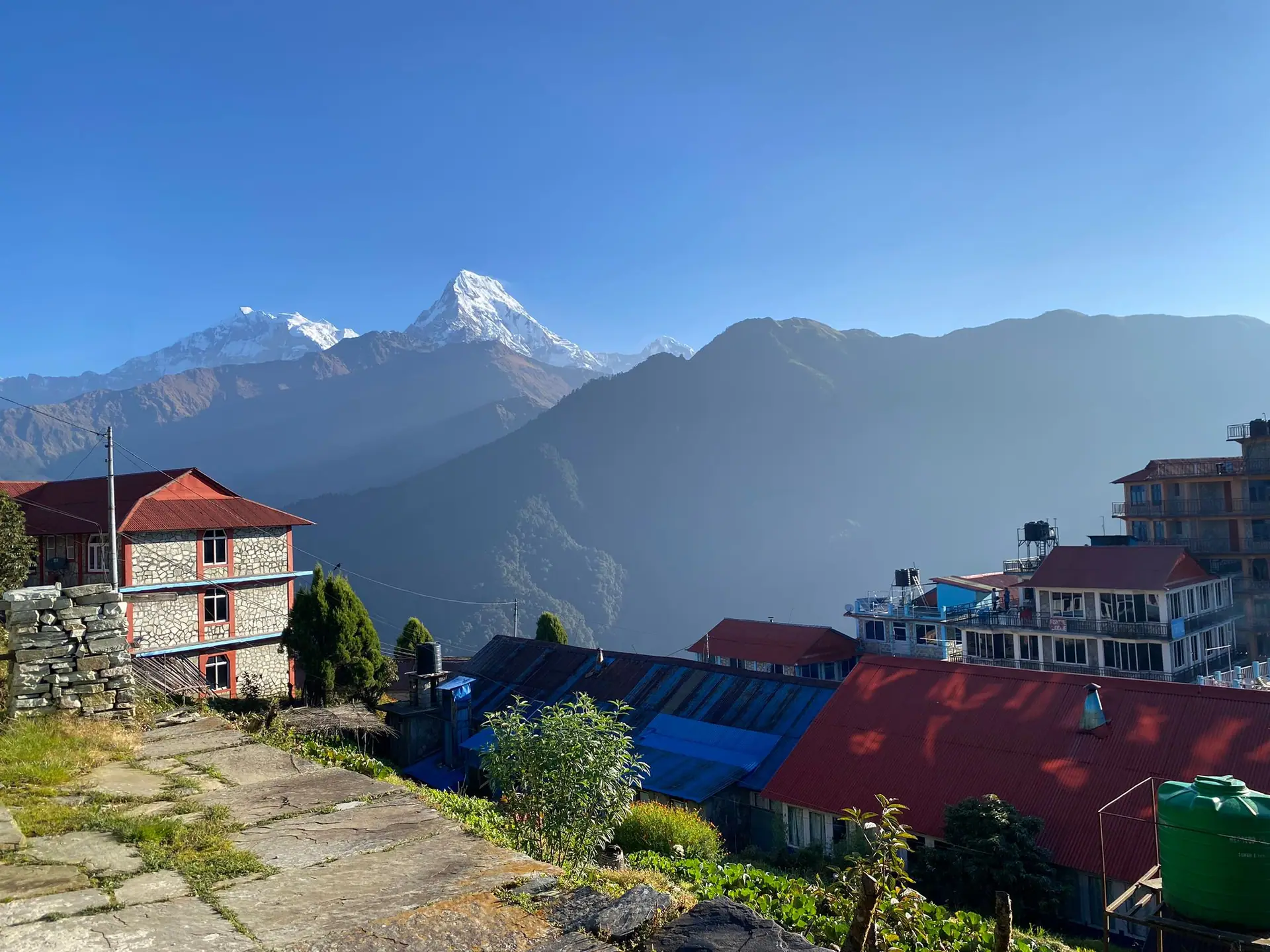
Most visitors to Pokhara sleep in Lakeside, a kilometre-long strip of cafés, gear shops and restaurants pressed against Phewa Lake. It is convenient, sociable and nowhere near as loud as it looks on a map. But if what you actually came for is a peaceful nature retreat, Pokhara has a second answer ten minutes past the last guesthouse: the villages around Fulbari, where the rice fields start where the pavement stops. This is an honest comparison of the two, so you can pick deliberately rather than by default.
Lakeside versus Fulbari: the honest contrast
Neither side is better — they simply do different jobs. Lakeside is infrastructure: an ATM every hundred metres, twenty-four-hour restaurants, rental scooters, paragliding desks, and someone to arrange a jeep at midnight. The villages north of town are the opposite: fields, birdsong, a shop that closes at eight, and a sky full of stars. What follows is what you actually feel on the ground, not a brochure.
- Noise — Lakeside has live music that runs to around midnight and traffic from six; in Fulbari the loudest evening sound is a television through a wall and the morning sound is a rooster. Light sleepers notice the difference by night two.
- Air — Lakeside's main strip carries dust and scooter exhaust in the dry season; the village air moves over fields and gets cleaned by rain, which matters if you are prone to congestion.
- Food — Lakeside offers fifty kitchens from Nepali thalis to wood-fired pizza; the farm offers one kitchen, cooking what was picked that morning. Different pleasures, and only one of them changes its menu with the weather.
- Sunrise — from Lakeside you watch the sun come up behind the lake and the hills; from a Fulbari terrace you watch Machhapuchhre and the Annapurnas turn pink while you hold your first cup of tea.
- Price — a mid-range Lakeside room runs about US$30 to US$60 a night; a farm room or bunkhouse in the village runs roughly US$18 to US$55, usually including breakfast and often dinner.
- Space — Lakeside rooms are boxed in by neighbours; village stays come with a garden, a hammock and a view that nobody is standing in front of.
Who each side actually suits
Choose Lakeside if you have two or three nights, you want to meet other travellers, you are flying out early from the domestic airport, or you are travelling with someone who would be restless in a village. It is also the right base for your first visit, when you have not yet seen Phewa Lake, the World Peace Pagoda or the Old Bazaar, and for anyone who wants to book a rafting trip or a day tour without explaining where they are staying.
Choose the villages if you are staying a week or longer, working remotely in the mornings, travelling with children, recovering from a trek, or simply worn down by cities — and if your version of a quiet week includes getting dirt under your fingernails, read our guide to volunteering in Pokhara first. Writers, photographers and yoga students get the most from it: the silence is productive, the light starts before six, and a week here passes at the pace of the household rather than the tourist strip. Many guests do both — a few nights in Lakeside on arrival, then out to the farm — which is what the rooms and rates at the farm are built around.
Want the quiet without losing Pokhara?
Fulbari is twelve kilometres from Lakeside — close enough for dinner in town, far enough to hear nothing.
See the farm roomsFarm-to-table: eating where your food grows
The phrase is used carelessly everywhere now, but a farm kitchen outside Pokhara means something literal: the vegetables in your dal were pulled from the bed that morning, the greens came from the patch behind the house, and the lemons in your tea were on the tree an hour ago. Nothing is trucked in, so the menu follows the season rather than the supply chain — cauliflower and mustard greens in winter, gourds and beans through the monsoon, a glut of citrus from December onwards.
For guests this changes the rhythm of a day in a small but noticeable way. Meals happen when the household eats, usually around one, and they are eaten together rather than ordered. If you have spent a week choosing dishes from a laminated menu, eating the same dal bhat your host eats — with a second helping pressed on you whether you asked for it or not — is a more memorable experience than another restaurant meal, and it costs a fraction of the price.
Yoga and meditation within reach
Peaceful is easy to claim and hard to schedule: a yoga practice at 5:30am in a town centre usually means headphones and traffic. Out in the villages the calculation inverts. The deck or the orchard is silent enough that you can hear your own breathing, the birds start before the light, and there is no class to walk to because the mat is already where you want it to be. Temple bells carry across the fields at dusk, and most guests find that a week of that settles them more than a fortnight of classes.
If you want instruction rather than solitude, organised yoga and meditation sessions run on site, from morning asana to guided meditation and pranayama — and Lakeside's studios are still a twenty-minute ride away when you feel like a class with other people. The typical pattern that works is morning practice at the farm, an afternoon in town, and dinner back under the stars.
Getting from Lakeside to Fulbari
The farm sits in Fulbari-11, roughly twelve kilometres north of the Lakeside strip — close enough to reach for dinner, far enough that the tour buses never come. Plan on thirty to forty-five minutes depending on traffic, and agree the fare before you get in, because Pokhara taxis are not metered.
By taxi
The simplest option, and cheap by international standards. Ask your hotel to call one, or take one from the ranks near the lakeside junction. Have the destination written down in Nepali, confirm the price before departure, and if you plan to return the same evening, agree a wait or a pickup time with the driver.
By local bus or scooter
Local buses run the Baglung and Kaski routes from the main park for a few rupees, though they stop wherever passengers flag them and rarely go door to door. Renting a scooter for the day gives you the most freedom — wear a helmet, carry cash, and photograph any existing scratches before you leave the rental shop.
With a pickup from the farm
The easiest arrival is to have us collect you. Send your flight or bus time when you check the available rooms and a car will be waiting at the airport, the bus park or your Lakeside hotel — no negotiation, no wrong turn, and someone who already knows which lane is yours.