
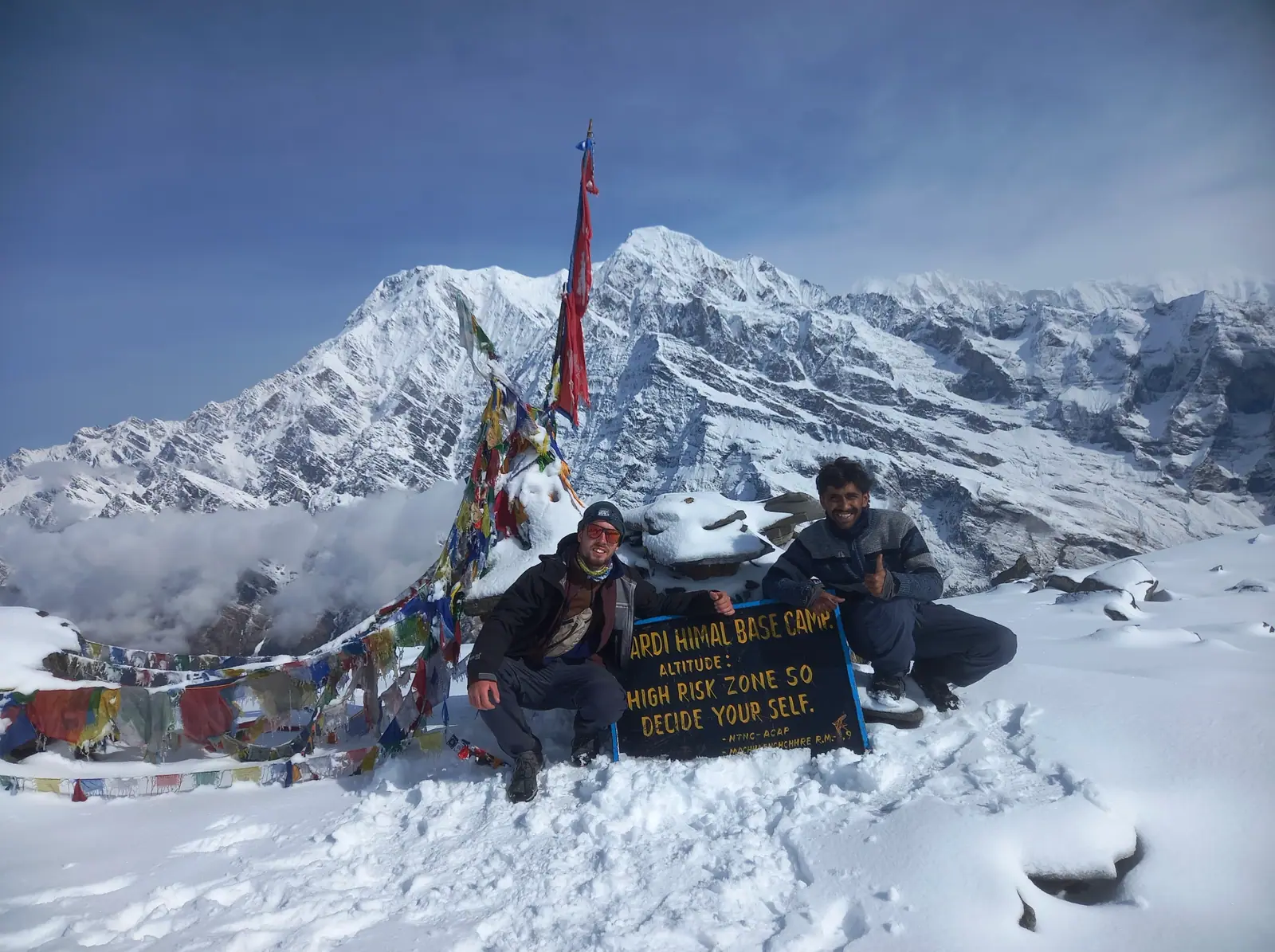
Ten days is enough to do both of these things properly: four days living on a farm outside Pokhara, five days walking the Mardi Himal trail, and a buffer day so a delayed jeep or a slow descent does not eat your flight home. This is the Nepal solo travel itinerary we hand to guests who want serious mountain time without giving up a quiet place to start and finish. It works for first-time trekkers, it works for people travelling alone, and it leaves you somewhere better than a Lakeside hostel to recover.
The shape of the ten days
The order matters. Starting at the farm lets you lose the jet lag at 820 metres, sort permits in town and walk some hills before real altitude begins. Finishing there means you descend from a 4,500-metre ridge to a bed in a garden with a hot shower and a meal waiting — not a six-hour bus to Kathmandu.
- Days 1–4 — the farm: arrive, two mornings of volunteering, one cultural day, one day for permits and gear.
- Day 5 — in: Kande to Australian Camp to Forest Camp, through oak and rhododendron.
- Day 6 — up: Forest Camp to Low Camp to High Camp at 3,580 metres.
- Day 7 — high point: alpine start for the base camp viewpoint at 4,500 metres, then back to camp.
- Day 8 — out: descend to Siding, a jeep back to Pokhara and the farm.
- Days 9–10 — recover: a slow day at the farm, and a spare day before you fly.
Days one to four: farm living before the trail
Arrival day is empty: check in, eat, sleep, walk the orchard before dark. Days two and three are working mornings from seven to one — harvest, weeding, compost, whatever the season is doing — with long afternoons of nothing in particular. That is the acclimatisation itself: hills, stairs and four hours of light work at low altitude beat a week of gym sessions.
Day four is logistics: permits in Pokhara, a rain jacket if yours is tired, a SIM card, cash for the trail, and an early night. If you are travelling solo and want company, ask the farm to pair you with a licensed local guide, which also covers the permit rules below.
Want this itinerary done properly?
We arrange licensed local guides, permits and a bed at the farm before and after the trail.
Browse trek plansDays five to eight: the Mardi Himal trail
Mardi Himal is the quiet cousin of Annapurna Base Camp: a ridgeline walk rather than a valley march, fewer teahouses, and a viewpoint most walkers never reach because they stop at Poon Hill. From the farm it starts with an hour's drive to Kande, a climb to Australian Camp and forest to Forest Camp; the path narrows each day as the valley drops away.
High Camp at 3,580 metres changes the trip: you sleep above the cloud, wake to Machhapuchhre filling the sky, and start early for the base camp viewpoint at about 4,500 metres — the highest point of the route. Descend the same way or drop through Siding, steeper but quieter, and take a jeep back into Pokhara by late afternoon. Our guided Mardi Himal and Annapurna itineraries follow this line with a licensed guide and a porter if you want one.
Acclimatisation without the drama
Coming from 820 metres, the risk is manageable but not zero. Sleep low, walk high: gain no more than 400 to 500 metres of sleeping altitude a day above 3,000, and take the base camp day as an out-and-back. Drink three litres a day, skip alcohol from Kande onwards, and treat headache plus nausea as a reason to descend rather than a reason to take a tablet. Diamox is a question for your doctor before you fly.
Fitness: what you actually need
No technical skill and no mountaineering gear — this is a walking route with steep days, not a climb. What you need is legs that can do five to six hours carrying a light pack, with 800 to 1,000 metres of ascent on the two hardest days. Walk uphill for two hours with a rucksack once a week for six weeks beforehand and you will be fine. Solo travellers underestimate the descent, which is harder on the knees than the climb — trekking poles earn their space.
Permits: ACAP, TIMS and your guide
Two documents cover this route. The Annapurna Conservation Area Permit, ACAP, costs NPR 3,000 for foreign trekkers — about US$25 — and is issued at the NTNC counters in Pokhara or Kathmandu, or online. It covers a single entry to every trail in the conservation area, so adding Poon Hill later does not cost twice.
The TIMS card, a rescue and registration record, costs NPR 2,000 for independent foreign trekkers and NPR 1,000 through a registered agency. Checkposts increasingly ask for ACAP and a guide's licence rather than TIMS, and since 2023 foreign trekkers on these routes are officially expected to travel with a licensed guide or a registered agency. Booking a local guide in Pokhara is therefore both the compliant and the useful choice: someone who knows which jeep runs from Siding and where to stop when a headache starts.
- ACAP — NPR 3,000 foreign / NPR 1,000 SAARC, single entry, counters and online.
- TIMS — NPR 2,000 independent / NPR 1,000 through an agency.
- Guide — officially expected for foreign trekkers on Annapurna routes since 2023.
- Insurance — cover helicopter evacuation above 4,000 metres; do not save money here.
Packing: farm days and trail days in one bag
One 35 to 45 litre pack covers both halves: the farm days ask for almost nothing and the trail days ask for layering rather than bulk.
- Broken-in boots with grip, plus light shoes or sandals for the farm and the teahouse.
- Base layer, fleece and a waterproof shell — the ridge gets wind and cloud every afternoon.
- Down jacket, warm hat, gloves, sun hat and sunglasses for High Camp and 4,500 metres.
- Sunscreen and lip balm, a refillable bottle plus purification, head torch, power bank and blister kit.
- Photocopies of passport and permits, and stationery or a small gift for the village school.
Why recovering at the farm beats a Lakeside hostel
The descent from Siding drops you into Pokhara in the late afternoon with wrecked knees and three days of your trip unused. The obvious move is a hostel on the strip, where the music starts at nine. The better one is a bed at the farm: hot water, a garden, dal bhat that keeps arriving, and nobody asking you to join a pub crawl. By the second morning your legs work again.
It also closes the loop: you walk the mountains that make the valley famous, then come back to the household you started in — usually with a request to help with something. That is the argument for a peaceful farm stay over a room in Lakeside in the first place. Use the last morning to map out your next dates, whether that is a longer trek or a slower version of this one.
What the ten days cost
A solo traveller on this itinerary spends the following — a working budget rather than a quote.
- Farm stay — from US$18 a night in the bunkhouse to US$55 for the suite, breakfast included; free under a work exchange.
- Permits — roughly US$40 for ACAP plus TIMS.
- Guide and porter — around US$25–35 a day and US$15–20 a day respectively, including food and lodge.
- Trail food and lodges — about NPR 1,000–1,500 a day for meals and a bed in season.
- Transport — taxis and the Kande and Siding transfers, perhaps US$30–50 across the trip.
- Insurance — US$50–150 for a policy with evacuation cover, which you should not skip.